
Sister Mary Ann Collins, OP, of the Sisters of Saint Dominic of Blauvelt, offered the following reflection on John 9:1–41 during Evening Vespers for the Fourth Week of Lent.
Have you ever looked at someone and not really seen them? I’m reminded of my first day ministering in a maximum-security prison for women. Although I wasn’t quite sure what to expect, I was so proud of myself. I thought I was doing great things, going to minister in prison to save the world!
When I met the staff and women that first day, they appeared to be an intimating lot. Heads down, no eye contact, suspiciously checking me out. Who was I, and what did I want with them? My cheery, “Good morning!” was answered with a grunt. I later learned the security staff were concerned I’d be too lenient and the women were very cautious with this new creature in their midst. Would I stay or leave like many others in their lives?
I began to wonder how we would ever connect? What had I gotten myself into?
As time went on, I began to build relationships. I saw beneath the surface and realized how wrong my first impressions were. I began to see the women as they really were, as God saw them. And they did the same for me; we began to really see each other. Before that I thought I could see. But I quickly realized I had been blind.
As I began to see, I learned their stories, their uniqueness, their dreams and their hopes. Amy shared with me how she connected with her children each night when they saw the moon rise and were reminded that the moon was their mother’s hug goodnight. Shanai told me about her 3 young children in their great-grandmother’s care in another state in the middle of the country. She shared how they were struggling and in need of so many services, services that Shanai tried to find for them from her prison cell.
I thought I could see. But I quickly realized I had been blind.
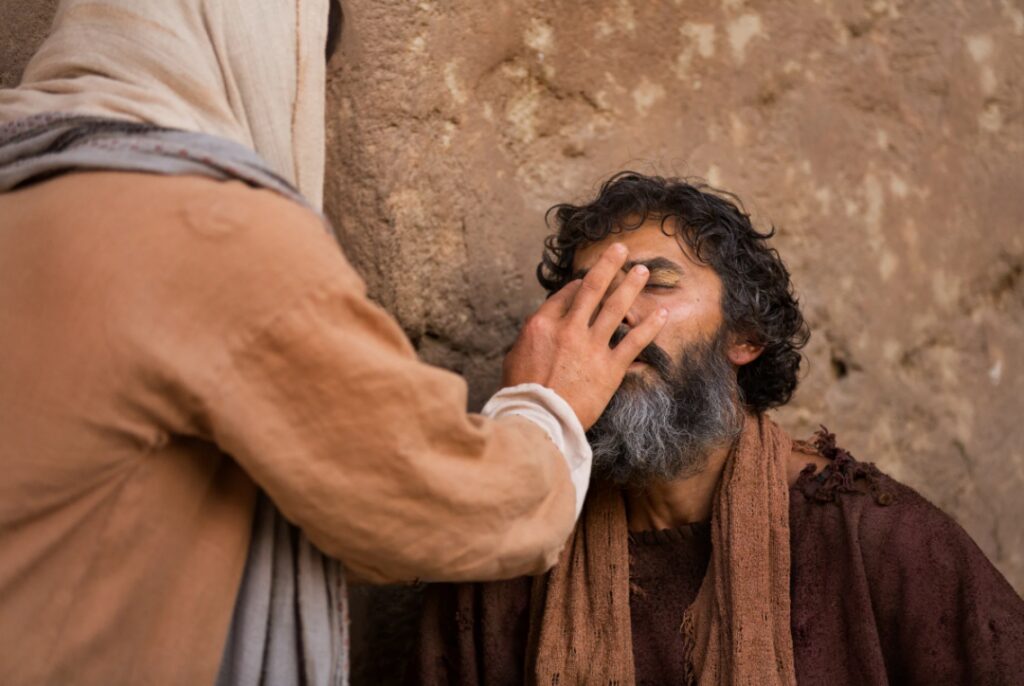
This is exactly where today’s gospel story John 9, begins, a story about blindness, the parable of the man born blind. Some commentators liken it to a one-act play in six scenes, with a large cast of characters. There are at least 12 disciples, a crowd of nosy neighbors, some Pharisees, two parents, the man himself, and Jesus. Jesus and the man born blind get most of the attention because they are the so-called sinners: the man because he was born blind, and Jesus because he healed on the sabbath. Only one person in the story cannot see with his eyes. Only one person is physically blind. Everyone else is blind in a different way.
I can imagine in that crowd of characters, many were spiritually blind. Was Jesus talking to them? How is Jesus talking to us today? Where are we in that crowd?
First, there is the disciples’ blindness. They see a man born blind and immediately ask, “Who sinned?” Their reflex is finding an explanation, not compassion. They reduce a human life to a theological problem. These were tax collectors and fishermen. They went back to their traditions and beliefs, and wanted an explanation for what was happening in front of them. When we encounter suffering and pain, do we look for someone to blame rather than someone to love? Assumption blinds us because it replaces curiosity with certainty.
Next, there is the parents’ blindness. They were on the margins already because everyone presumed they had sinned. They know their son was blind. They know he now sees. But fear keeps them silent. What will the neighbor’s say? Afraid of being expelled from the synagogue, they refuse to speak the truth. This is the blindness of fear. Fear blinds us by shrinking our courage. It makes us value safety over truth. How often do we see clearly—but stay silent?
Then comes the Pharisees’ blindness. They have vision, education, and authority, yet remain blind. Their blindness is pride or spiritual certainty. The miracle did not meet their religious standards. They know the law so well that they can no longer recognize grace. Their certainty about how God must act prevents that from recognizing how God is acting. Their hearts were closed. They couldn’t rejoice that a blind man could now see. Pride blinds us when we prefer being right over being transformed.
And finally, we see the healed man’s former blindness. He was honest, visible, and vulnerable. The man knew his need. He knew his deepest desire, and put himself out there. He wanted to see. He knows what he does not have. And because he knows, he is open to receiving. He does not argue theology. He does not defend doctrine. He simply says, “I was blind, now I see.” We see his transformation from a blind, begging man to one whose faith deepens as he stands up for Jesus. This is the great paradox: the only person aware of his blindness is the only one who ends up truly seeing.
Jesus ends with a sobering truth: “Those who have never seen will see, and those who have made a great pretense of seeing will be exposed as blind.”
Lent invites us not to condemn ourselves, but to be honest. To know our needs. To stop pretending we see clearly when we really don’t.
I was so blind in the beginning of my prison ministry. I thought I knew all about helping the women. Even that word, “helping” isn’t the best mindset. Slowly, I began to see. I began to see their faith. I began to see their exceptional love for their children. I began to see their innate goodness despite the worst thing they had ever done.
This evening we ask, “God, help me see.” Because the moment we admit we cannot see fully is the very moment light and sight begins to enter.
“Jesus, I need to see. Amen.”